
Can Water Filters Remove PFOA, PFOS and Microplastics from Drinking Water?
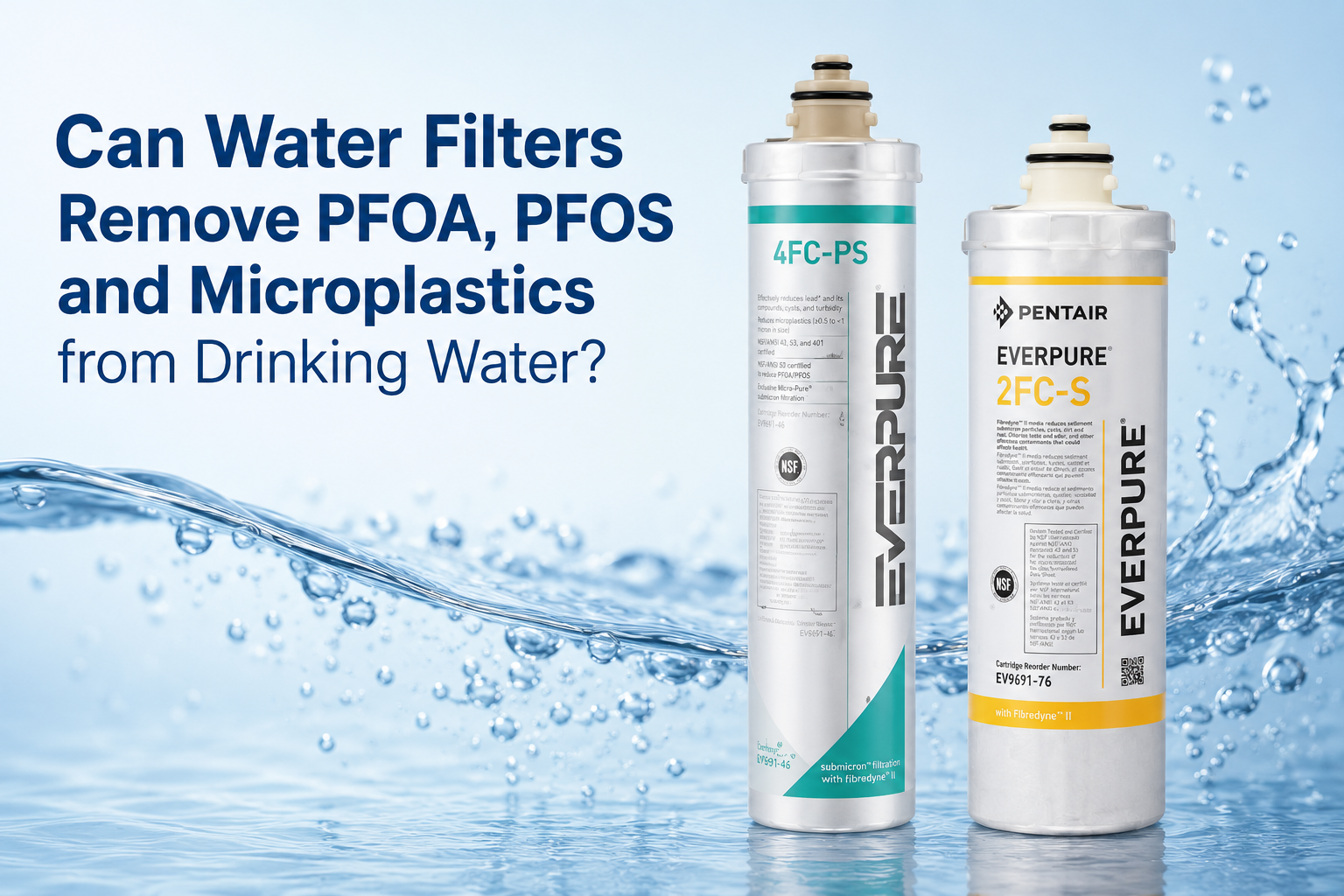
Concerns about emerging contaminants such as PFAS, PFOA, PFOS and microplastics have increased interest in advanced water filtration. But can a water filter actually remove them?
The answer is yes, certain water filtration systems can reduce these contaminants, but not every filter has the same capabilities. The filtration technology, filter media, micron rating and independent certification all matter.
What Are PFOA and PFOS?
PFOA (perfluorooctanoic acid) and PFOS (perfluorooctane sulfonic acid) belong to a larger family of synthetic chemicals known as PFAS, or per- and polyfluoroalkyl substances. [US EPA]
PFAS have been used in many industrial and consumer applications because of properties such as resistance to heat, oil and water. Many PFAS can persist in the environment for long periods of time because they break down very slowly, which is why they are sometimes referred to as “forever chemicals.” [US EPA]
Can Water Filters Remove PFOA and PFOS?
Some can. The ability of a filtration system to reduce PFOA and PFOS depends on the treatment technology, filter design and specific contaminant-reduction performance of the system.
Learn more about our water filter systems in Singapore .
According to the US Environmental Protection Agency, treatment technologies used for PFAS reduction include activated carbon, ion-exchange resins and high-pressure membrane systems such as reverse osmosis (RO). [US EPA]
Activated carbon has been particularly well studied for the reduction of longer-chain PFAS, including compounds such as PFOA and PFOS. [US EPA]
However, simply having a carbon filter does not automatically mean that a particular product is certified to reduce PFOA or PFOS.
When PFAS reduction is specifically required, it is important to look for independently tested products carrying an appropriate contaminant-reduction claim. NSF identifies NSF/ANSI 53 for drinking water treatment units. [NSF]
Can Water Filters Remove Microplastics?
Microplastics are small plastic particles found throughout the environment. Unlike dissolved PFAS chemicals, microplastics are particles, meaning that sufficiently fine filtration processes can physically capture them.
Research reviewing microplastics in drinking water treatment has found that treatment processes designed to remove particles can significantly reduce microplastics. Removal performance can depend on factors such as particle size, shape, treatment technology, water conditions and the different stages of the treatment process. [Research Review]
For consumers and businesses looking specifically for verified microplastic reduction, NSF/ANSI 401 certification can include a microplastics reduction claim. It is important to check the certification and performance claims of the individual water filter rather than assuming that every fine-micron filter provides the same level of microplastic reduction. [NSF]
PFAS vs Microplastics: Filtration Works Differently
An important distinction is that micron size alone does not tell you whether a water filter can reduce PFAS.
Microplastics are particles and can be physically captured through sufficiently fine filtration. PFOA and PFOS, on the other hand, are dissolved chemical contaminants, so their reduction typically relies on technologies such as adsorption, ion exchange or membrane separation. [US EPA]
This is why the best way to evaluate a water filter is to check its performance data and specific contaminant-reduction certifications rather than choosing a filtration system based only on its micron rating.
Choosing the Right Water Filter in Singapore
Singapore's tap water is safe to drink straight from the tap and its quality is regulated according to Singapore's drinking water requirements and the World Health Organisation Guidelines for Drinking-water Quality. [PUB Singapore]
A water filtration system should therefore be selected according to the application's specific requirements rather than based on claims that Singapore's tap water is unsafe.
For homes, offices, cafés, restaurants and commercial facilities, considerations can include filtration performance, flow rate, capacity, filter technology and certified contaminant-reduction claims.
GFS Innovation supplies water filtration solutions in Singapore for residential, office, F&B and commercial applications. Speak with our team to determine the appropriate filtration system based on your water requirements and application.
Looking for a water filtration solution for your home, office, restaurant or commercial premises? Explore our water filter systems or contact GFS Innovation to discuss your filtration requirements.
